
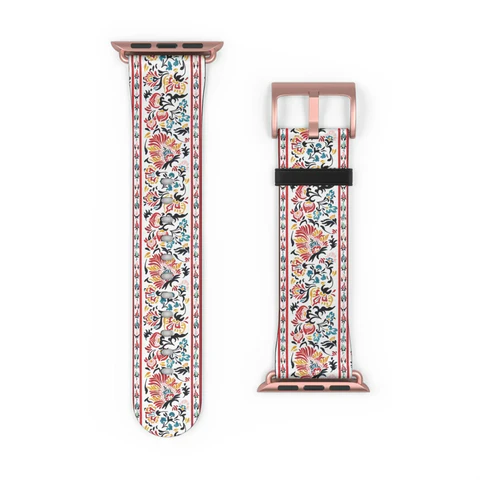
It measures your heart rate with remarkable accuracy. It counts your steps, monitors your sleep, reminds you to breathe, tells you when to stand up, and delivers your messages before you have even thought to check your phone. The Apple Watch is a genuinely impressive piece of technology, a small computer strapped to your wrist that knows more about your physical state on any given Tuesday than your doctor did a decade ago.
But here is the thing: it cannot do it on its own. It cannot tell anyone anything about who you are.
That is not a criticism. It is an opportunity. Because the Apple Watch was designed with something that most wearable technology ignores entirely: the understanding that a watch is a personal object, that it sits on your body and becomes part of how you present yourself to the world, and that the experience of wearing it should be something you have genuine agency over. The watch is the platform. The band is the expression. And most people are leaving that expression completely unused.
The default band is fine. It is comfortable, and it does exactly what it needs to do. But fine and comfortable is not the same as personal, and personal is what a wrist accessory has always been about.
Why Watch Bands Are the Most Expressive Thing on Your Wrist
There is a long history of the watch band carrying more personality than the watch itself. Long before smartwatches, the choice of strap on a mechanical watch was one of the most considered decisions a watch owner could make: leather or metal, formal or casual, the colour that worked with the dial, the texture that felt right against the skin. It was understood, almost universally, that the band defined the character of the watch in a way that the case alone never could.
That instinct is even more relevant with the Apple Watch, because the watch face itself is broadly similar across the wrists of millions of people worldwide. What distinguishes one Apple Watch from another is almost entirely the band and watch bands that are designed with genuine cultural artistry and creative depth, which make that distinction immediately, visibly, and memorably.
A band drawing from the textile traditions of the Andes, with those bold, high-contrast stripe sequences in colours that have been produced by Quechua weavers in the highlands of Peru and Bolivia for centuries, communicates something specific about the person wearing it. A band inspired by the batik dyeing traditions of Java, with its fluid, wax-resist patterns in warm browns and creams and burnt orange, says something equally specific but entirely different. Neither one is trying to be for everyone. Both are exactly right for the person who chooses them.
That specificity is the whole point. The world is full of accessories trying to appeal to the broadest possible audience, which means they end up belonging to no one in particular. A culturally rooted watch band belongs to someone who noticed it, chose it deliberately, and wears it because it reflects something true about their relationship to the wider world.
What Makes Culturally Inspired Watch Bands Worth Seeking Out Specifically
The Apple Watch band market is enormous. There are thousands of options across every price point, material, and design category you can think of. Most of them are genuinely interchangeable, the same basic silicone in a slightly different shade, the same woven nylon in a colour that was probably trending eighteen months ago and will feel dated in six more, the same clear band that seemed interesting in the product photo and turned yellow by the third week.
Finding something genuinely worth wearing in that landscape requires knowing what you are looking for, and for people who care about design that carries real meaning and visual staying power, culturally inspired watch bands are consistently the answer.
The reason comes back to the same principle that makes heritage design compelling across every category. Genuine cultural traditions have been tested and refined over time in a way that no trend-driven design process can replicate. The colour relationships in a traditional West African Kente cloth weave were not chosen by a committee trying to predict what would sell next quarter. They were developed and refined across generations of skilled weavers who understood colour, contrast, and visual rhythm at a level that most contemporary designers never reach. When those relationships are translated faithfully onto a watch band, the result has a visual authority that is immediately perceptible even to someone who cannot articulate why.
Here is the single most important thing to look for beyond the design itself:
- The clasp and lug attachment need to be engineered with the same care as the design: A band that looks extraordinary but develops clasp play within a few months, or whose lug attachment becomes loose over time, is not just an annoyance but a potential safety issue, so look for bands with solid metal hardware, tight tolerances at the Apple Watch attachment points, and a clasp mechanism that operates smoothly and securely through thousands of open-and-close cycles.
Beyond hardware, the material that touches your skin needs to earn its place there. A beautiful exterior finish on a band with rough interior stitching or an edge treatment that irritates during exercise is not a band you will wear consistently, and a band you do not wear consistently cannot do what it is supposed to do, which is to be part of your life.
The Art of Rotating Bands and Why It Changes Everything
One of the most enjoyable discoveries for anyone who starts investing in quality culturally inspired watch bands is how naturally a rotation develops. You begin with one band that felt unmissable, and then you find a second that suits a completely different context, and then a third that bridges the two, and before long you have a small collection that covers every version of your week with something genuinely appropriate and genuinely loved.
The rotation is not just about variety. It is about matching the expressiveness of your wrist to the energy of the moment you are moving into. The bold Kente-inspired band for a creative presentation where you want your confidence visible. The refined Moroccan tile pattern band for a dinner with people whose opinion of your taste you care about. The earthy, Mud Cloth-inspired band for a weekend morning where the ambition is entirely different, but the care in what you wear is identical.
This approach of treating the watch band as a rotating element of a considered personal style rather than a set-and-forget accessory decision is genuinely transformative. It turns something most people decide once and forget about into one of the most nimble and expressive elements of a daily wardrobe.
The coordination possibilities extend naturally beyond the band itself. When your watch band shares a design family or colour story with your phone case, your tote bag, or your laptop cover, the whole carry starts to feel like it was assembled by someone who thinks carefully about how things relate to each other and that quality of attention is something people notice without always being able to say exactly why the whole look feels so right.
Conclusion
Your wrist is one of the most visible pieces of real estate on your body, and the band on your Apple Watch is its most expressive element. Choosing that band with the same care and curiosity you bring to the rest of your life is not an indulgence it is entirely consistent with taking your personal style seriously in a way that extends all the way to the details. The right watch bands do not just hold your Apple Watch on your wrist. They tell a story about who you are, where your curiosity points, and how you engage with the extraordinary richness of global design tradition.
The Global Wanderer has built a collection of watch bands that understands all of this completely. Every band in their range draws from a genuine cultural tradition researched deeply, translated thoughtfully, and produced with materials and hardware built for daily wear over the long term. West African textile geometry, South Asian folk art colour, East Asian craft restraint, Latin American weaving boldness, Middle Eastern architectural pattern, the collection covers an extraordinary range of the world’s most compelling design traditions and makes all of them wearable on your wrist today. Browse their full range, find the tradition that speaks most directly to something in you, and let your Apple Watch finally become as expressive as everything else about how you move through the world.
Frequently Asked Questions
Q1: Do culturally inspired watch bands fit all Apple Watch models and series?
Apple Watch bands use a standardised lug system across most models, which means bands are generally compatible across a wide range of series from Series 1 through the current lineup. The key variable is the case size. 38mm/40mm/41mm bands and 42mm/44mm/45mm/49mm bands are not interchangeable, so always confirm which size your Apple Watch case is before purchasing. The Ultra models use the larger lug size but may have slightly different requirements, so checking specific compatibility is always worthwhile.
Q2: How do I care for a culturally inspired fabric or printed watch band to keep it looking its best?
The care approach depends on the material. For fabric bands, spot cleaning with a damp cloth and mild soap handles most everyday dirt without risking damage to the design. For bands with printed surfaces, avoid submerging in water or using abrasive cleaning tools, and wipe gently with a soft damp cloth as needed. Allowing bands to dry completely before wearing after any contact with water prevents moisture from being trapped against the skin and extends the life of both the material and the design.
Q3: Are these bands comfortable enough to wear during exercise and everyday physical activity?
Comfort during activity depends primarily on the material of the band and the fit at the wrist. Quality bands designed for everyday wear should use materials with enough flexibility to move with the wrist during normal activity, and interior surfaces smooth enough to prevent irritation during extended wear. For intensive exercise sessions involving significant sweat, a dedicated sports band may be more appropriate, with the culturally inspired band returning to the wrist for the rest of the day. Many people find a natural rotation develops between activity bands and everyday wear bands.
Q4: Can I wear a culturally inspired watch band in both casual and professional settings?
Yes, and this versatility is one of the things that makes well-designed cultural bands so appealing. The key is choosing the design and colour palette thoughtfully. A band with a refined geometric pattern in quieter tones reads as sophisticated and considered in a professional context while remaining genuinely interesting. A band with bolder, more vibrant colours and patterns leans naturally toward creative or casual contexts. Having one or two bands that work across different settings is entirely achievable within the culturally inspired category.
Q5: What makes a culturally inspired watch band a better gift than a standard Apple Watch band?
The story is what makes it better, the story behind the design and the story it tells about the person giving the gift. A standard Apple Watch band is a practical item that arrives without context. A culturally inspired band arrives with a connection to a specific artistic tradition, a specific place, and a specific human history of making beautiful things. For someone who wears their Apple Watch every day and cares about how it looks, a band that adds that layer of meaning to their daily wrist experience is a gift that lands with genuine impact and is used and appreciated every single time they put it on.
Leave a Reply